


第12回アジア栄養ネットワークシンポジウムを開催しました。
開催報告
※本シンポジウムは終了しております。ご参加いただき誠にありがとうございました。
-
日時:2026年1月29日(木)午後1時~午後3時 日本標準時(JST)
-
参加費:無料 ※参加登録要
-
開催形式:オンライン開催(ウェビナー)
-
開催リーフレット:PDF
 (3421KB)
当日の内容(プログラム/講演概要)
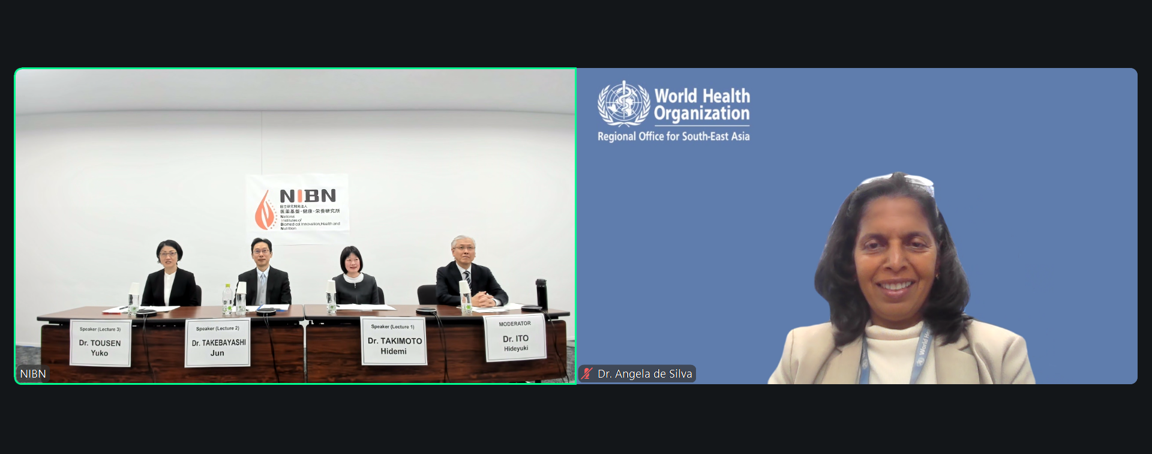
※以下の資料は開催言語(英語)のみでの掲載となります。
プログラム |
演者・所属 |
関連資料 |
|---|---|---|
| 開会挨拶 |
吉武 徹 医薬基盤・健康・栄養研究所 理事長特任補佐 |
要約(70KB) |
|
基調講演 「東南アジアにおける健康的な食政策の実施を支援する栄養プロファイリング」 |
Dr. Angela de Silva Regional Adviser Nutrition and Health for Development, WHO Regional Office for South East Asia |
|
|
講演 1 「日本版栄養プロファイリングモデルの開発と実装」 |
瀧本 秀美 国立健康・栄養研究所 所長 |
|
|
講演 2 「日本版栄養プロファイリングモデル加工食品版の開発:栄養基準値・食文化を考慮したローカライゼーション戦略」 |
竹林 純 国立健康・栄養研究所 食品保健機能研究センター 食品分析・表示研究室 室長 |
|
|
講演 3 「日本版栄養プロファイリングモデル料理版の開発とアジア地域での応用可能性」 |
東泉 裕子 国立健康・栄養研究所 食品保健機能研究センター 食品安全・機能研究室 室長 |
|
| 閉会挨拶 |
瀧本 秀美 国立健康・栄養研究所 所長 |
要約(65KB) |

質疑応答
※以下の質疑応答は開催言語(英語)のみでの掲載となります。
| 参加者からの質問 | 講演者の回答 |
|---|---|
|
To Dr. Angela de Silva
What are your views on investors evaluating or valuing food companies based on their nutritional performance? |
Yes, this is a option, similar to enviornmental sustainbility as an option for investors. Investors could be able to value based on healthfullness of product portfolis- based on a transparent nutrient profiling system. But also need to think of aspects such as aggressive and ethical marketing of unhealthy foods and beverages to children. An example of investor focused reporting of industry is Access to Nutrition Initiative's (ATNi) reports on compliance and violations of breast milk substitutes marketing in countries. However, I am not aware of companies offering this information as part of their investment strategies- though it maybe occuring. Challenges include the use of a harmonized nutrient profiling system, and standardized disclosures by industry. |
|
To Dr. Angela de Silva
In Indonesia, many foods consumed daily are sold in traditional markets without nutrition labels. Is nutrient profiling primarily intended for packaged and ultra-processed foods? How might countries such as Indonesia adapt the model for informal food systems? Additionally, could nutrient profiling be used as a supportive tool to encourage healthier reformulation of traditional and local foods, rather than solely as a regulatory measure? |
The informal food sector is one of the most difficult to improve across all of Asia — varieties and recipes vary. Food profiling rather than nutrient profiling may be the answer, where adding a fruit or vegetable to a meal could be promoted. Also reformulation of base ingredients such as using healthier oil, whole grain flour etc. This is possible, but needs efforts — municipal level may work best to incentivize vendors. Consumer demand needs to change. |
|
To Dr. Angela de Silva Could you share any examples of good practices or community-based interventions that apply nutrient profiling in settings where overnutrition and undernutrition coexist among children, with the aim of promoting healthier eating? |
We don't use the models directly at community level- but basically the models are applied to various policies which may be implemented - such as public food procurement in shcools, or cafetaira policies. of course the models can be also used to benchmakr foods and provide evidence to increase community understanding and awarenss of unhealthy diets etc |
|
To Dr. Angela de Silva I would like to ask whether a food classification system for school canteens has already been introduced, and whether it can also be applied to food outlets located both inside and outside school premises. |
Thank you. We are in the process of development- as I mentioned in my pesentation. Not finalized, but I understand that several countries are developing simplified food classifications for school cafetarias etc |
|
To any of the panelists
Could you please tell us about FOPNL in your country? |
In the South‑East Asia region, three countries have already implemented front‑of‑pack (FOP) food labelling systems: Sri Lanka, Thailand, and Indonesia.Sri Lanka uses a traffic‑light labelling system; hailand and Indonesia use Guideline Daily Amounts (GDA) presented in monochrome; Malaysia currently displays energy levels on the front of packs; In addition, India has drafted a Health Star Rating system, and Bangladesh is in the process of drafting a black octagonal warning label. |
|
To any of the panelists
Could you please tell us about FOPNL in your country? |
In Japan, Front-of-Pack Nutrition Labeling (FOPNL) is voluntary, but the Consumer Affairs Agency (CAA) published national guidelines to standardize the format. This revised format focuses on displaying the amounts of energy, protein, fat, carbohydrates, and sodium (salt equivalent) per serving, along with their percentages relative to Nutrient Reference Values (NRVs) for adults. Our Japanese NPM (NPM-PFJ/DJ) takes a different approach, as it is specifically designed to encourage industry reformulation by providing a holistic health evaluation through ratings. Although there is no direct link between the Japanese FOPNL guidelines and our Japanese NPM at present, I believe our model will complement the Japanese FOPNL in the future to further enhance consumer health. |
|
To Dr. TAKEBAYASHI Jun
Are there any published papers or reports available on the previous research related to nutrient profiling, especially the development of a Nutrient Profile Model (NPM) for processed foods in Japan? |
Thank you for your interest. The development and methodology of our nutrient profiling models were published in 2024. 1. Takebayashi, J., Takimoto, H., Okada, C., et al. (2024). Development of a nutrient profiling model for processed foods in Japan. Nutrients, 16(17), 3026. https://doi.org/10.3390/nu16173026 2. Tousen, Y., Takebayashi, J., Okada, C., et al. (2024). Development of a nutrient profile model for dishes in Japan version 1.0: A new step towards addressing public health nutrition challenges. Nutrients, 16(17), 3012. https://doi.org/10.3390/nu16173012 |
|
To Dr. TAKEBAYASHI Jun
|
Thank you for your very important question. The NPM-PFJ is primarily designed as a public health tool to prevent non-communicable diseases (NCDs) and obesity in the general population. The scoring algorithm specifically addresses NCD risks by penalizing high sodium (for hypertension) and high energy/sugars (for diabetes and obesity), while rewarding dietary fiber, protein, and FVNL. To ensure the model is tailored to the Japanese population, the reference values were adapted based on multiple national standards such as Dietary Reference Intakes (DRIs) for Japanese (2020). |
|
To Dr. TOUSEN Yuko
I have a question regarding the dish-based NPM. Have you tested, or are you planning to test, its validity by comparing the judgments of the Japanese NPM (NPM-JP) with those of the Health Star Rating (HSR) system, which uses a similar algorithm, and the Choices International NPM, which is product-group specific and threshold-based? |
Thank you very much for your question. For the processed-food version of the Japanese NPM (NPM-PFJ 1.0), we have already confirmed its validity by examining the correlation with the Health Star Rating (HSR). Using 668 processed foods from the Standard Tables of Food Composition in Japan, we observed a very strong positive correlation between the NPM-PFJ final scores and HSR (Pearson’s r = 0.939, p < 0.01), which supports the robustness of the model. For the dish-based version as well, we have conducted a similar validation using HSR, and we obtained a comparable level of correlation to that seen in the processed-food version. Regarding comparisons with other international NPMs such as the Choices International system, we have not yet carried out a full analysis, but we would like to consider such evaluations as needed in the future. |
|
To Dr. TOUSEN Yuko
I have a question regarding how consumers distinguish between nutrients of concern—particularly “positive” (beneficial) nutrients and “negative” (nutrients to limit)—when evaluating mixed dishes. |
Thank you very much for your question. Mixed dishes often contain both nutrients to limit, such as sodium, and nutrients to encourage, such as vegetables and legumes. For this reason, the Japanese dish-based NPM is designed to evaluate both aspects together. In particular, seasonings and cooking oils are difficult to assess as individual processed foods, but by evaluating them within a dish, we can assess their nutritional impact based on the actual amount people consume. The model first gives points for nutrients to limit, and then subtracts positive points for vegetables, protein, and dietary fiber. This allows us to reflect the overall nutritional balance of the dish. For example, even if a curry contains high sodium, the vegetables or legumes in it still contribute positive points. In this way, the model captures both strengths and weaknesses at the same time, and helps support balanced food choices. |
| To Dr. Takebayashi and Dr. Tousen Both NPM-PFJ and NPM-DJ are based on the Australian Health Star Rating (HSR) system. Could you please share the rationale for choosing HSR as the base model, rather than Nutri-Score or the WHO SEARO model? |
We selected the Health Star Rating (HSR) as our base model because its transparent and traceable algorithm allowed for direct recalibration using Japanese standards, such as the DRIs (2020), NRVs (2015), and Health Japan 21 goals. While Nutri-Score and the HSR shares a similar scoring/rating algorithm, HSR provides a greater number of food categories with specific nutrient criteria, making it more adaptable to the complexities of Japanese food culture. Regarding the WHO SEARO model, we did not use it as a direct reference for our scoring system because it is a threshold-based model. However, we consulted the WHO SEARO model indirectly when establishing our specific food category settings. |
|
To Dr. TAKEBAYASHI Jun
How can a Nutrient Profile Model be implemented in a country where a complete food composition table is not available? |
The absence of a comprehensive food composition table presents a significant obstacle to developing a Nutrient Profile Model (NPM). Even for our NPM-PFJ version 1.0, our reliance on the Standard Tables of Food Composition in Japan represents a major limitation, as missing data values directly compromise the model's accuracy. Because a scoring model calculates a final score by balancing all evaluated components—including energy, saturated fat, sugars, sodium, protein, fiber, and FVNL—missing data has a substantial impact. The evaluation relies heavily on the specific interaction between risk-increasing "base points" and risk-reducing "modifying points". Consequently, in contexts where reliable food composition data is scarce, a threshold model focused on individual nutrient criteria may be more practical than a scoring model. While scoring models are designed to rank foods, threshold models focus on classifying them, making them a more feasible starting point when complete nutritional data is unavailable for the majority of products. |
| To Dr. TAKEBAYASHI Jun Could you please clarify whether NPM-PFJ is used both for calculating the Health Star Rating and for guiding food reformulation efforts in Japan? It would be helpful to understand how the model supports these two complementary objectives. |
The NPM-PFJ is designed to bridge the gap between nutritional evaluation and product improvement. As a scoring tool aligned with Japanese standards, it provides a quantifiable metric for a product's 'healthiness.' This evaluation serves as a direct catalyst for reformulation by illustrating how specific adjustments—such as sodium reduction—directly improve a product's rating. For instance, lowering the salt content in bread can objectively raise its score from 3.0 to 3.5, offering manufacturers a clear incentive to optimize their recipes. Ultimately, evaluation and reformulation are not separate goals but complementary drivers intended to enhance the nutritional quality of processed foods in Japan. |
| To Dr. Tousen and Dr. Takimoto It is very interesting and encouraging to learn that Japan has developed a dish-based NPM. Given the wide variation in recipes across restaurants and households, could you kindly explain how the model is designed to accommodate such variability? |
Thank you very much for your question. As you mentioned, recipes for dishes vary widely across restaurants and households. For the development of the Japanese dish-based NPM, we first used standard dishes commonly eaten in Japanese households to establish the thresholds. These provide a neutral and culturally appropriate reference. Of course, many types of dishes exist, and their intended use can differ. Food culture also varies greatly. Therefore, in our research, we are collecting a wide range of actual dish data and evaluating them using the Japanese NPM to examine how well the model can accommodate real-world variability. In the future, as we accumulate more data, we hope to clarify the range of variation within each dish category and consider refining the thresholds or the scoring algorithm, depending on the purpose of use. This will help the model better reflect the diversity of dishes consumed in daily life. |
トップページ「新着情報」欄に表示する画像

研究成果 / イベント / 公募 / お知らせ のいずれかを入力してください。
お知らせ