


The 12th Asian Network Symposium on Nutrition
Event Report
This symposium has concluded. We sincerely thank everyone who participated.
- Date & Time: January 29, 2026 (Thursday), 1:00 PM – 3:00 PM (Japan Standard Time, JST)
- Participation Fee: Free of charge (Advance registration required)
- Format: Online (Webinar)
- Event Leaflet: PDF
 (3455KB)
Program / Presentation Abstracts
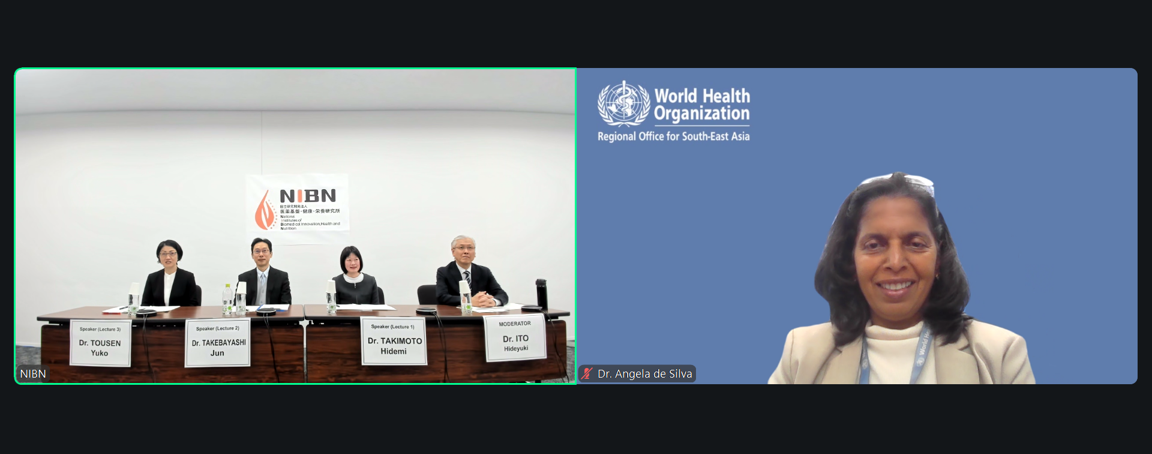
| Program | Speakers and Affiliations | Related Documents |
|---|---|---|
|
Opening Remarks
|
Mr. YOSHITAKE Toru Special Assistant to the President of NIBN |
Summary(70KB) |
|
Keynote Speech Nutrient Profiling to Support Healthy Diet Policy Implementation in South East Asia |
Dr. Angela de Silva Regional Adviser Nutrition and Health for Development, WHO Regional Office for South East Asia |
|
|
Lecture 1 The Development and Implementation of the Japanese Nutrient Profile Model |
Dr. TAKIMOTO Hidemi Executive Director, NIHN, NIBN |
|
|
Lecture 2 Development of a Nutrient Profile Model for Processed Foods in Japan: A Localization Strategy Considering Nutritional Standards and Food Culture |
Dr. TAKEBAYASHI Jun Head, Laboratory of Food Analysis and Labeling, Center for Food Function and Labeling, NIHN, NIBN |
|
|
Lecture 3 Development of a Japanese Version Nutrient Profile Model for Dishes and Its Applicability Across Asia |
Dr. TOUSEN Yuko Head, Laboratory of Food Safety and Function, Center for Food Function and Labeling, NIHN, NIBN |
|
| Closing Remarks |
Dr. TAKIMOTO Hidemi Executive Director, NIHN, NIBN |
Summary(65KB) |

Q&A
| Questions from Participants | Speakers’ Responses |
|---|---|
|
To Dr. Angela de Silva
What are your views on investors evaluating or valuing food companies based on their nutritional performance? |
Yes, this is a option, similar to enviornmental sustainbility as an option for investors. Investors could be able to value based on healthfullness of product portfolis- based on a transparent nutrient profiling system. But also need to think of aspects such as aggressive and ethical marketing of unhealthy foods and beverages to children. An example of investor focused reporting of industry is Access to Nutrition Initiative's (ATNi) reports on compliance and violations of breast milk substitutes marketing in countries. However, I am not aware of companies offering this information as part of their investment strategies- though it maybe occuring. Challenges include the use of a harmonized nutrient profiling system, and standardized disclosures by industry. |
|
To Dr. Angela de Silva
In Indonesia, many foods consumed daily are sold in traditional markets without nutrition labels. Is nutrient profiling primarily intended for packaged and ultra-processed foods? How might countries such as Indonesia adapt the model for informal food systems? Additionally, could nutrient profiling be used as a supportive tool to encourage healthier reformulation of traditional and local foods, rather than solely as a regulatory measure? |
The informal food sector is one of the most difficult to improve across all of Asia — varieties and recipes vary. Food profiling rather than nutrient profiling may be the answer, where adding a fruit or vegetable to a meal could be promoted. Also reformulation of base ingredients such as using healthier oil, whole grain flour etc. This is possible, but needs efforts — municipal level may work best to incentivize vendors. Consumer demand needs to change. |
|
To Dr. Angela de Silva Could you share any examples of good practices or community-based interventions that apply nutrient profiling in settings where overnutrition and undernutrition coexist among children, with the aim of promoting healthier eating? |
We don't use the models directly at community level- but basically the models are applied to various policies which may be implemented - such as public food procurement in shcools, or cafetaira policies. of course the models can be also used to benchmakr foods and provide evidence to increase community understanding and awarenss of unhealthy diets etc |
|
To Dr. Angela de Silva I would like to ask whether a food classification system for school canteens has already been introduced, and whether it can also be applied to food outlets located both inside and outside school premises. |
Thank you. We are in the process of development- as I mentioned in my pesentation. Not finalized, but I understand that several countries are developing simplified food classifications for school cafetarias etc |
|
To any of the panelists
Could you please tell us about FOPNL in your country? |
In the South‑East Asia region, three countries have already implemented front‑of‑pack (FOP) food labelling systems: Sri Lanka, Thailand, and Indonesia.Sri Lanka uses a traffic‑light labelling system; hailand and Indonesia use Guideline Daily Amounts (GDA) presented in monochrome; Malaysia currently displays energy levels on the front of packs; In addition, India has drafted a Health Star Rating system, and Bangladesh is in the process of drafting a black octagonal warning label. |
|
To any of the panelists
Could you please tell us about FOPNL in your country? |
In Japan, Front-of-Pack Nutrition Labeling (FOPNL) is voluntary, but the Consumer Affairs Agency (CAA) published national guidelines to standardize the format. This revised format focuses on displaying the amounts of energy, protein, fat, carbohydrates, and sodium (salt equivalent) per serving, along with their percentages relative to Nutrient Reference Values (NRVs) for adults. Our Japanese NPM (NPM-PFJ/DJ) takes a different approach, as it is specifically designed to encourage industry reformulation by providing a holistic health evaluation through ratings. Although there is no direct link between the Japanese FOPNL guidelines and our Japanese NPM at present, I believe our model will complement the Japanese FOPNL in the future to further enhance consumer health. |
|
To Dr. TAKEBAYASHI Jun
Are there any published papers or reports available on the previous research related to nutrient profiling, especially the development of a Nutrient Profile Model (NPM) for processed foods in Japan? |
Thank you for your interest. The development and methodology of our nutrient profiling models were published in 2024. |
|
To Dr. TAKEBAYASHI Jun
|
Thank you for your very important question. The NPM-PFJ is primarily designed as a public health tool to prevent non-communicable diseases (NCDs) and obesity in the general population. |
|
To Dr. TOUSEN Yuko
I have a question regarding the dish-based NPM. Have you tested, or are you planning to test, its validity by comparing the judgments of the Japanese NPM (NPM-JP) with those of the Health Star Rating (HSR) system, which uses a similar algorithm, and the Choices International NPM, which is product-group specific and threshold-based? |
Thank you very much for your question. |
|
To Dr. TOUSEN Yuko
I have a question regarding how consumers distinguish between nutrients of concern—particularly “positive” (beneficial) nutrients and “negative” (nutrients to limit)—when evaluating mixed dishes. |
Thank you very much for your question. |
|
To Dr. Takebayashi and Dr. Tousen |
We selected the Health Star Rating (HSR) as our base model because its transparent and traceable algorithm allowed for direct recalibration using Japanese standards, such as the DRIs (2020), NRVs (2015), and Health Japan 21 goals. While Nutri-Score and the HSR shares a similar scoring/rating algorithm, HSR provides a greater number of food categories with specific nutrient criteria, making it more adaptable to the complexities of Japanese food culture. Regarding the WHO SEARO model, we did not use it as a direct reference for our scoring system because it is a threshold-based model. However, we consulted the WHO SEARO model indirectly when establishing our specific food category settings. |
|
To Dr. TAKEBAYASHI Jun
How can a Nutrient Profile Model be implemented in a country where a complete food composition table is not available? |
The absence of a comprehensive food composition table presents a significant obstacle to developing a Nutrient Profile Model (NPM). Even for our NPM-PFJ version 1.0, our reliance on the Standard Tables of Food Composition in Japan represents a major limitation, as missing data values directly compromise the model's accuracy. |
|
To Dr. TAKEBAYASHI Jun |
The NPM-PFJ is designed to bridge the gap between nutritional evaluation and product improvement. As a scoring tool aligned with Japanese standards, it provides a quantifiable metric for a product's 'healthiness.' This evaluation serves as a direct catalyst for reformulation by illustrating how specific adjustments—such as sodium reduction—directly improve a product's rating. For instance, lowering the salt content in bread can objectively raise its score from 3.0 to 3.5, offering manufacturers a clear incentive to optimize their recipes. Ultimately, evaluation and reformulation are not separate goals but complementary drivers intended to enhance the nutritional quality of processed foods in Japan. |
|
To Dr. Tousen and Dr. Takimoto |
Thank you very much for your question. |
トップページ「What's New」欄に表示する画像

Achievement / Events / News のいずれかを入力してください。
News